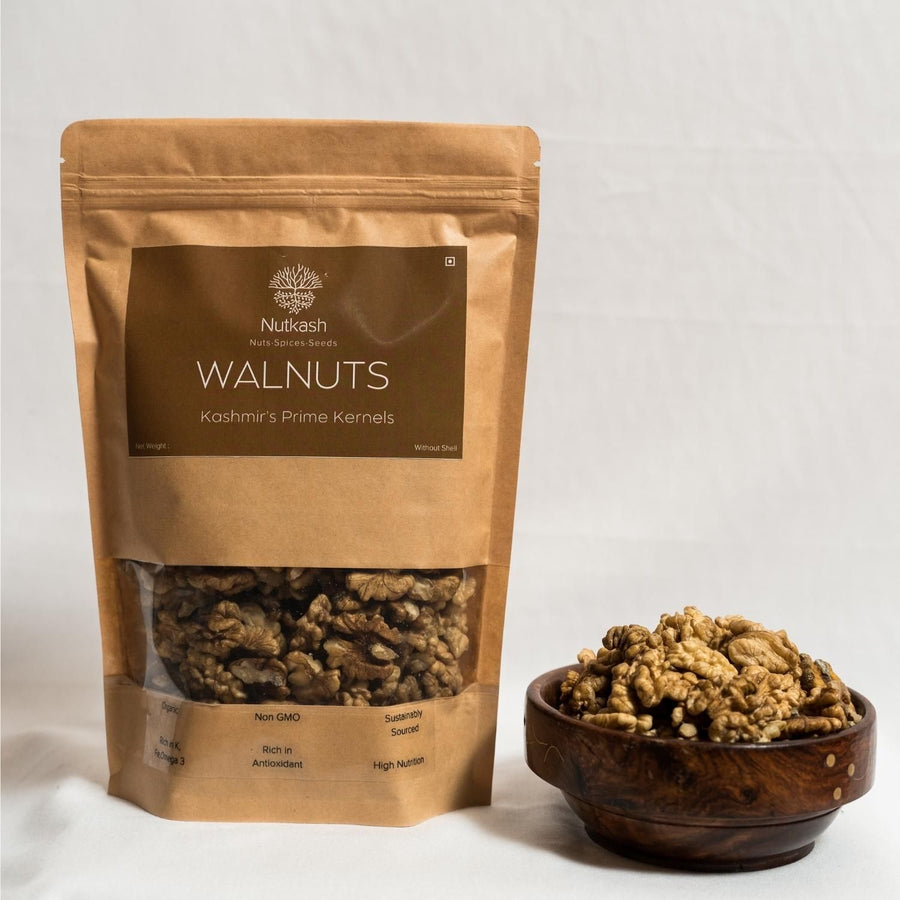
Walnut Kernels — Kashmir | Without Shell | 500g
Thin-Shell Walnuts · Sopore · Kashmir
Thin-shell Kashmiri akhrot from Sopore. 2.5g omega-3 per 4 halves. Raw, skin on.
Kashmiri walnuts from Kupwara and Baramulla have a thinner shell and a larger, creamier kernel — brain-shaped, crunchy, naturally creamy inside. Four halves a day gives you a good source of plant-based omega-3. Don't discard the brown skin — that is where most of the antioxidants are.
4 halves give you a good source of plant-based omega-3 — the same fat your brain needs daily. Keep the brown skin on: most antioxidants are there.
Regular walnut eating supports healthy cholesterol levels as part of a balanced diet. 4 halves daily is enough — the effect builds over weeks, not days.
Walnuts contain melatonin — the hormone your body uses to fall asleep. Eat 4–6 halves an hour before bed instead of scrolling.
ALA omega-3 supports the body's natural anti-inflammatory response with consistent daily intake over 6–8 weeks. Skin and joint comfort are usually the first things people notice.
What it does
ALA omega-3 — what your brain is made of.
- Your body converts ALA from walnuts into DHA — the main fat your brain is made of. The conversion is slow, which is why eating walnuts consistently over weeks matters more than eating a lot at once.
- The WAHA study found that adults who ate walnuts daily for 2 years showed slower cognitive decline — especially those who didn't eat many nuts before.
- Potential benefits develop with consistent consumption as part of a healthy lifestyle.
2.5g ALA omega-3 per handful — one of the better plant sources for heart health.
- Four halves give you 2.5g of ALA omega-3 — the dose used in major heart health studies.
- A major study across thousands of people found those who ate walnuts regularly had significantly fewer heart problems.
- LDL oxidation reduces over 90 days of daily eating. Raw, skin on.
ALA omega-3 supports the body's natural anti-inflammatory response — consistent eating is key.
- Walnuts contain natural compounds that your gut bacteria convert into substances that reduce swelling and soreness in the body.
- These natural compounds help support the body's normal cellular processes, which may contribute to recovery and overall wellbeing.
- The gut bacteria that do this work build up over weeks of consistent walnut eating.
Walnuts are a complete plant protein source — overlooked because of the fat focus.
- A 28g serving of walnuts (4–5 halves) provides 4.3g of protein. Compared to almonds (6g) they're slightly lower, but the protein comes packaged with omega-3, fibre, and polyphenols — a combination no protein powder can replicate.
- The fat-protein-fibre combination creates sustained satiety — you stay full longer than any carbohydrate-based snack. 6–8 halves in the morning significantly reduces mid-morning hunger.
- For vegetarians and vegans, walnuts are one of the most nutrient-dense protein sources available — especially because the omega-3 ALA that accompanies the protein is otherwise hard to get without fish.
ALA omega-3 — what your brain is made of.
- Your body converts ALA from walnuts into DHA — the main fat your brain is made of. The conversion is slow, which is why eating walnuts consistently over weeks matters more than eating a lot at once.
- The WAHA study found that adults who ate walnuts daily for 2 years showed slower cognitive decline — especially those who didn't eat many nuts before.
- Potential benefits develop with consistent consumption as part of a healthy lifestyle.
2.5g ALA omega-3 per handful — one of the better plant sources for heart health.
- Four halves give you 2.5g of ALA omega-3 — the dose used in major heart health studies.
- A major study across thousands of people found those who ate walnuts regularly had significantly fewer heart problems.
- LDL oxidation reduces over 90 days of daily eating. Raw, skin on.
ALA omega-3 supports the body's natural anti-inflammatory response — consistent eating is key.
- Walnuts contain natural compounds that your gut bacteria convert into substances that reduce swelling and soreness in the body.
- These natural compounds help support the body's normal cellular processes, which may contribute to recovery and overall wellbeing.
- The gut bacteria that do this work build up over weeks of consistent walnut eating.
Walnuts are a complete plant protein source — overlooked because of the fat focus.
- A 28g serving of walnuts (4–5 halves) provides 4.3g of protein. Compared to almonds (6g) they're slightly lower, but the protein comes packaged with omega-3, fibre, and polyphenols — a combination no protein powder can replicate.
- The fat-protein-fibre combination creates sustained satiety — you stay full longer than any carbohydrate-based snack. 6–8 halves in the morning significantly reduces mid-morning hunger.
- For vegetarians and vegans, walnuts are one of the most nutrient-dense protein sources available — especially because the omega-3 ALA that accompanies the protein is otherwise hard to get without fish.
Kashmiri thin-shell walnuts crack with hand pressure. The kernel is light golden, mild, and creamy — not dark or bitter like the commercial variety.
Four walnut halves provide a good source of plant-based omega-3 (ALA). Potential benefits develop with consistent consumption — it takes regular eating, not a one-time dose.
By month 3, consistent daily walnut eating may support healthy cholesterol levels. This doesn't happen in a week — it compounds with consistency.
Is this for you?
How to eat it
High-temperature roasting may reduce some heat-sensitive nutrients and antioxidants. Buy raw. Eat raw.
Don't peel the skin off — that brown papery skin has most of the antioxidants. If the bitterness bothers you, soak overnight — it reduces significantly without losing most of the benefit.
The consistent daily dose used in studies. Morning, with your first meal. Four to five halves — not a handful twice a day.
Walnut fat goes rancid at room temperature within 2–3 months of opening. Signs of rancidity: bitter aftertaste, paint-like smell, oily surface. Once open, store in an airtight container in the fridge — they last 6 months. Vacuum-sealed and unopened: 2+ years. Never store near onions or strong-smelling food.
What customers say
Common questions
Browse the full range
View all →

 -31%
-31%
 -15%
-15%
 -10%
-10%
 -22%
-22%
 -25%
-25%
 -6%
-6%
 -25%
-22%
-25%
-22%
 -31%
-31%