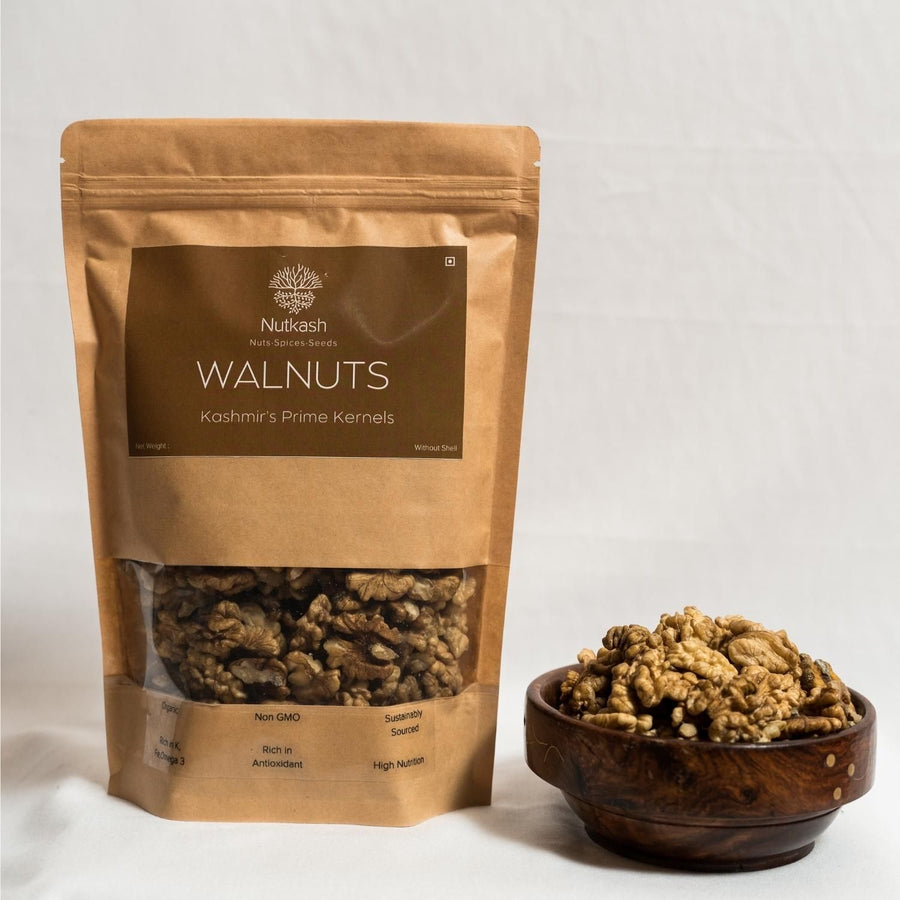
Walnut Kernels — Kashmir | Without Shell | 500g
Thin-Shell Walnuts · Sopore · Kashmir
Thin-shell Kashmiri akhrot from Sopore. 2.5g omega-3 per 4 halves. Raw, skin on.
Most walnuts sold as Kashmiri walnuts online are Dehradun or Chinese varieties, relabelled. Real Kashmiri akhrot from Sopore has a thin shell that cracks with hand pressure — not a tool. The kernel is light golden, mild, and creamy, not the dark bitter walnut from supermarkets. Kashmir produces approximately 90% of India's domestic walnut crop. The kagzi variety — paper-thin shell — is the premium grade. The omega-3 content (2.5g ALA per 4 halves) is why cardiologists and neurologists both recommend walnuts daily. If you find kashmiri walnuts online that are smooth and uniformly dark, they are not Kashmiri. One rule: eat them raw. Roasting damages the omega-3 fats and reduces antioxidants by up to 30%. Our walnuts are named to Sopore — the source region is on the pack.
4 halves daily = full omega-3 requirement. The same fat your brain is made of. Don't skip the brown skin — that's 90% of the antioxidants.
Reduces bad cholesterol (LDL) and improves blood vessel flexibility. The PREDIMED trial ran 7,000 people on walnuts — results were significant.
Walnuts contain melatonin — the hormone your body uses to fall asleep. Eat 4–6 halves an hour before bed instead of scrolling.
ALA omega-3 from walnuts reduces inflammatory markers — CRP and IL-6 — over 6–8 weeks of consistent daily intake. Most effective when replacing a processed snack, not just adding to an existing diet. Skin and joint symptoms are usually first to change.
What it does
ALA omega-3 — what your brain is made of.
- Your body converts ALA from walnuts into DHA — the main fat your brain is made of. The conversion is slow, which is why eating walnuts consistently over weeks matters more than eating a lot at once.
- The WAHA study found that adults who ate walnuts daily for 2 years showed slower cognitive decline — especially those who didn't eat many nuts before.
- Most people notice clearer mornings and steadier attention after a month of daily eating.
2.5g ALA — the cardiologist dose.
- Four halves give you 2.5g of ALA omega-3 — the dose used in major heart health studies.
- A major study across thousands of people found those who ate walnuts regularly had significantly fewer heart problems.
- LDL oxidation reduces over 90 days of daily eating. Raw, skin on.
Reduces swelling and soreness over time.
- Walnuts contain natural compounds that your gut bacteria convert into substances that reduce swelling and soreness in the body.
- These same substances help your body clear out old damaged cells — which is linked to faster muscle recovery and slower ageing.
- The gut bacteria that do this work build up over weeks of consistent walnut eating.
Walnuts are a complete plant protein source — overlooked because of the fat focus.
- A 28g serving of walnuts (4–5 halves) provides 4.3g of protein. Compared to almonds (6g) they're slightly lower, but the protein comes packaged with omega-3, fibre, and polyphenols — a combination no protein powder can replicate.
- The fat-protein-fibre combination creates sustained satiety — you stay full longer than any carbohydrate-based snack. 6–8 halves in the morning significantly reduces mid-morning hunger.
- For vegetarians and vegans, walnuts are one of the most nutrient-dense protein sources available — especially because the omega-3 ALA that accompanies the protein is otherwise hard to get without fish.
ALA omega-3 — what your brain is made of.
- Your body converts ALA from walnuts into DHA — the main fat your brain is made of. The conversion is slow, which is why eating walnuts consistently over weeks matters more than eating a lot at once.
- The WAHA study found that adults who ate walnuts daily for 2 years showed slower cognitive decline — especially those who didn't eat many nuts before.
- Most people notice clearer mornings and steadier attention after a month of daily eating.
2.5g ALA — the cardiologist dose.
- Four halves give you 2.5g of ALA omega-3 — the dose used in major heart health studies.
- A major study across thousands of people found those who ate walnuts regularly had significantly fewer heart problems.
- LDL oxidation reduces over 90 days of daily eating. Raw, skin on.
Reduces swelling and soreness over time.
- Walnuts contain natural compounds that your gut bacteria convert into substances that reduce swelling and soreness in the body.
- These same substances help your body clear out old damaged cells — which is linked to faster muscle recovery and slower ageing.
- The gut bacteria that do this work build up over weeks of consistent walnut eating.
Walnuts are a complete plant protein source — overlooked because of the fat focus.
- A 28g serving of walnuts (4–5 halves) provides 4.3g of protein. Compared to almonds (6g) they're slightly lower, but the protein comes packaged with omega-3, fibre, and polyphenols — a combination no protein powder can replicate.
- The fat-protein-fibre combination creates sustained satiety — you stay full longer than any carbohydrate-based snack. 6–8 halves in the morning significantly reduces mid-morning hunger.
- For vegetarians and vegans, walnuts are one of the most nutrient-dense protein sources available — especially because the omega-3 ALA that accompanies the protein is otherwise hard to get without fish.
Kashmiri thin-shell walnuts crack with hand pressure. The kernel is light golden, mild, and creamy — not dark or bitter like the commercial variety.
In month 1, most people notice clearer mornings and steadier focus. Four walnut halves daily builds the omega-3 your brain needs — it takes consistent eating, not a one-time dose.
By month 3, daily walnut eating measurably reduces harmful cholesterol. This doesn't happen in a week — it compounds with consistency.
Is this for you?
How to eat it
Roasting damages the omega-3 fats and reduces antioxidants by up to 30%. Buy raw. Eat raw.
Don't peel the skin off — that brown papery skin has most of the antioxidants. If the bitterness bothers you, soak overnight — it reduces significantly without losing most of the benefit.
The consistent daily dose used in studies. Morning, with your first meal. Four to five halves — not a handful twice a day.
Walnut fat goes rancid at room temperature within 2–3 months of opening. Signs of rancidity: bitter aftertaste, paint-like smell, oily surface. Once open, store in an airtight container in the fridge — they last 6 months. Vacuum-sealed and unopened: 2+ years. Never store near onions or strong-smelling food.
What customers say
These crack easily and kernel is big. No bitterness at all. Supermarket walnuts taste bitter in comparison now. Great quality.
Very fresh, no rancid smell at all. Creamier than store bought. Whole family is happy with taste and quality. ❤️
Kashmiri walnuts are genuinely different from the regular ones. Bigger kernel, no bitterness. Will keep reordering.
Delivery was fast and product was very fresh. No regrets at all. Better quality than anything I've tried before this.
The walnut daily habitWalnut Kernels — Kashmir | Without Shell | 500g ritual
Four halves at breakfast, every single day. Raw, skin on. The omega-3 your brain and heart need — from a named Kashmiri orchard, not a bulk trader.


Common questions
Browse the full range
View all →
 -31%
-31%
 -35%
-35%
 -12%
-12%
 -22%
-22%
 -25%
-25%
 -3%
-25%
-3%
-25%
 -22%
-3%
-22%
-3%
 -31%
-35%
-31%
-35%